
9 February 2026
Professor Antonino Zichichi passed away peacefully in his sleep this morning. He was born in Trapani in 1929 into an ancient family from Erice. In 1963 he founded the Ettore Majorana Centre for Scientific Culture; in 1982 he promoted the Erice Declaration for Peace; he conceived the INFN National Gran Sasso Laboratory of the INFN (Italian National Institute for Nuclear Physics), of which he later became president; he discovered the antideuteron at CERN in Geneva; and he was Professor Emeritus of Advanced Physics at the University of Bologna and president and founder of the Centro Fermi. He is survived by three children, five grandchildren, and one great-grandchild
Antonino Zichichi, one of the leading Italian figures in high-energy physics, passed away today, Monday 9 February, at the age of 96. Professor Emeritus of Advanced Physics at the University of Bologna, President of the Italian National Institute for Nuclear Physics (INFN) from 1977 to 1982, and founder and director in 1963 of the interdisciplinary Ettore Majorana Centre for Scientific Culture in Erice, Zichichi represented one of the most passionate voices of scientific culture in the second half of the twentieth century.
After his years of training in Palermo and his early career between Fermilab in Chicago and CERN in Geneva, where in 1965 he led the research group that first observed the antideuteron, an antimatter particle composed of an antiproton and an antineutron, Zichichi emerged as a key figure in the world’s major international laboratories. His results and discoveries were numerous and fundamental, including nuclear antimatter, the production of heavy meson pairs with positive and negative strangeness (the decisive proof of the existence of the quantum number of strangeness in the subnuclear universe), and effective energy in QCD. Equally important were his inventions, among them an electronic circuit for measuring the time of flight of subnuclear particles and a new technology for the construction of high-precision polynomial magnetic fields.
Many major projects in international physics are linked to his name: the LEP at CERN projects, the HERA project at DESY, and the INFN National Gran Sasso Laboratory. He led numerous landmark experiments in elementary particle physics and held positions of responsibility at both the European level (President of the European Physical Society) and the national level (President of the Italian National Institute for Nuclear Physics from 1977 to 1982). He also chaired the NATO Committee on Disarmament Technologies and represented the EEC on the Scientific Committee of the International Science and Technology Center in Moscow.
From 1986 onward, he served as President of World Lab, an association supporting scientific projects in developing countries. He was President of the World Federation of Scientists, of the Historical Museum of Physics, and of the “E. Fermi” Center for Studies and Research. He received more than sixty awards and honours in Italy and abroad.
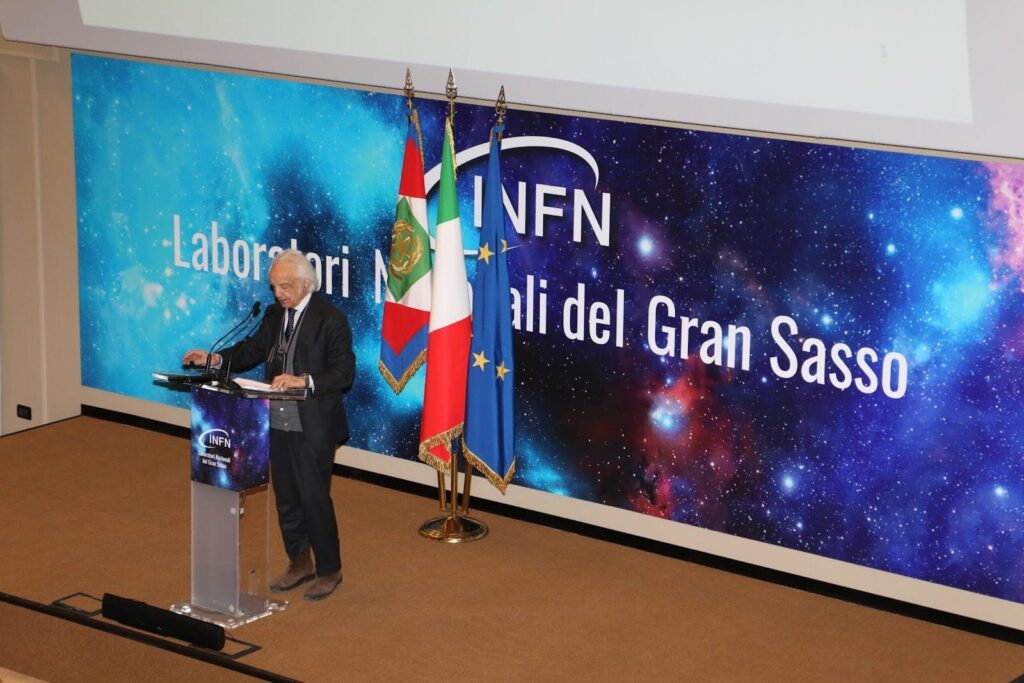
“With the passing of Nino Zichichi, INFN and the entire scientific community lose a figure of extraordinary energy and vision,” commented Antonio Zoccoli, President of INFN. “Zichichi was a man of science with remarkable curiosity and enthusiasm, capable of moving authoritatively within the great arenas of international research while at the same time looking ahead with foresight to the development of our country’s scientific infrastructure. As President of INFN, he made a decisive contribution to strengthening the Institute, and he was responsible for the idea and realization of the National Gran Sasso Laboratory, now recognized as among the most important research centers in the world and an integral part of our history. Founder and driving force of the interdisciplinary Ettore Majorana Centre for Scientific Culture, he turned that place into a laboratory for dialogue among scientists from different countries, convinced that scientific cooperation could serve as a concrete tool for diplomacy and peace-building. His commitment to building bridges between science, culture, and society was constant, rooted in the belief that fundamental research is not merely a technical endeavour, but a cornerstone of human progress. In this time of mourning, INFN stands close to his family and to all those who shared with him the path of research”.
“Antonino Zichichi marked an extraordinary era for science and for the dissemination of scientific knowledge in Italy. His vision in establishing INFN’s Gran Sasso National Laboratories has left us an immense legacy: the world’s most important underground physics laboratories, where thousands of scientists from the foremost international scientific organizations are engaged in astroparticle physics research,” states Ezio Previtali, Director of the Gran Sasso National Laboratories. “The concept of an international research center such as the Gran Sasso Laboratories serving as a crossroads for scientists who, although originating from diverse backgrounds, cultures, and institutions, collaborate in fundamental research is fully consistent with the activity that Antonino Zichichi consistently pursued. It is a vision that also understands science as a means of diplomacy, enabling peoples to engage in dialogue around a shared objective.”
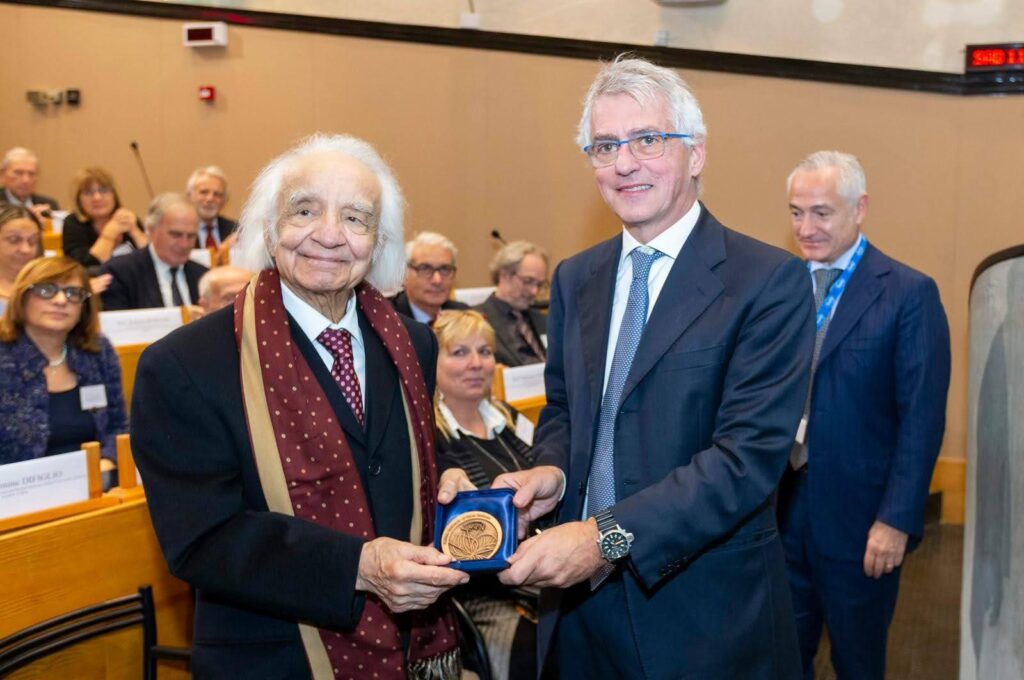
Professor Antonino Zichichi receives the “INFN Medal” from INFN President Antonio Zoccoli on the occasion of the celebrations marking the 60th anniversary of the founding of the Ettore Majorana Centre for Scientific Culture. Photograph courtesy of EMFCSC, photo by N. Lombardi.